Category Archives: Loved it

The Death of Stalin – Director, Armando Iannucci

deathofstalin_01

Armando Iannucci is the director of great political satire most notably VEEP starring Julia Louis-Dreyfus of Seinfeld fame. This movie is very much in that tradition. As satire both VEEP and this film move between comedy and making you feel slightly uncomfortable. This film tells the story of Stalin’s death and the subsequent events as members of the politburo fight for power and control. Stalin was one of the world’s most cruel and controlling dictators and his sudden death left a void that created a real crisis for the Soviet Union. The contest mainly between Khrushchev and Beria, the head of the secret service, was a devious and ruthless competition for power. Iannucci however manages to create a comic look at the struggle without taking away from the cruelty of the regime or the power struggle. The film did not shy away from the violence and reign of terror that Stalin created but managed to build comic relief and distraction in the relationships among the surviving members of the politburo. The cast is amazing including Steve Buscemi and Michael Palin among other lesser known character actors. The acting was smart with all the key roles contributing to the overall story. The Q and A was one of the best I have attended. Iannucci and four of the actors including Buscemi were there. Iannucci and Buscemi were particularly eloquent, funny and informative in their comments and we learned a lot about how the film was put together including rehearsals and use of improvisation when necessary. All in all an excellent experience and a film worth your time to see.

http://www.tiff.net/tiff/the-death-of-stalin/

Ukiyo-e Heroes, Director – Toru Tokikawa

This was one of my favourite films and damn it – also Japanese. However in this case it focusses on a Canadian artist and immigrant to Japan. David Bull is the artist who became intrigued with the ancient art of Japanese woodcuts or Ukiyo-e. This is a complex but beautiful art form that is in decline as modern techniques have changed how artists work around the world. Bull is one of a very few remaining woodcut artists in Japan and he is looking for ways to increase interest in the art form and maintain its traditions. As part of this he partners with a younger American artist who also had an interest in the techniques. Jed Henry is the American living in Utah and two communicate primarily through Skype. Jed is an artist interested in creating images of comic book heroes and works with manga and anime styles common to Japan. He creates the images and David Bull creates the woodcuts to reproduce them in the traditional style. While following their story we learn much about woodcutting style, its limits and its qualities. We also see how these two artists have created a successful market for this traditional Japanese art form blending it with modern popular images. You can find their work and order it if you like at their website: http://ukiyoeheroes.com/

I recommend a visit – it’s a great site and the images are beautiful.

Ramen Heads, Director – Koki Shigeno

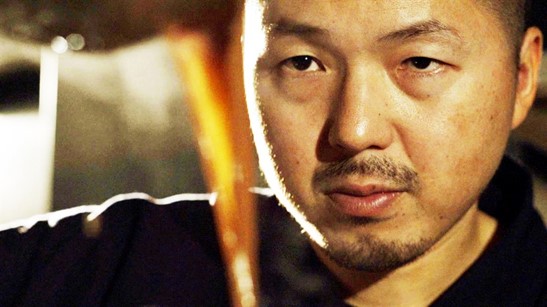
Another Japanese film and Japanese director. Not sure how this happened but I was not disappointed in any of them. This time a documentary about food, really good food. Ramen is a noodle based food that might be called the poutine of Japan. We are introduced to the current leading Ramen chef in Japan, Osamu Tomita. He has one the top prize for ramen restaurants in Japan four years in a row. We are taken into his kitchen and restaurant to learn the secrets of great ramen. We learn that this is a blending of carefully prepared noodles with just the right texture and flavourful stocks made from a variety of different ingredients. Trust me, you don’t always want to see the ramen stock being prepared but trust me, the chefs take this very seriously and the variety of styles and flavours are critical to success. The ramen restaurants in Japan are small and the queues to get in are, in the case of Osamu Tomita’s restaurant, long and the food in great demand. The whole culture around food and ramen in Japan is unique and there is much to learn. The director was there for a Q and A which was fun but his introduction to the film was best. He told us to sit back and enjoy and if at the end we felt hungry his effort in making the film would have been worthwhile. I can tell you that many in the audience were starving and looking on line for the nearest ramen restaurant.

Pre-Crime, Directors – Mathias Heeder and Monika Hielscher

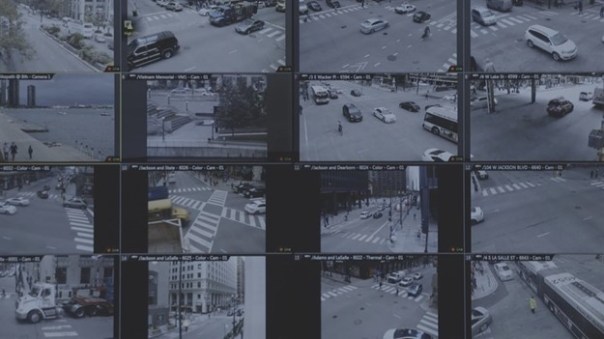
Have you ever seen the Tom Cruise film Minority Report? The movie is based on a classic Phillip Dick sci-fi story in which police have the ability to predict who will commit crimes and arrest them for a “pre-crime” and punish them. Minority Report finds Cruise caught in this web of surveillance that includes not just predicting who will commit crime but also how this kind of surveillance influences product promotion and involves a total invasion of personal privacy. What this documentary shows us is that we are not all that far from this dystopian world. The online world and computerized products is collecting unlimited information about all of us and we are willing participants as we grant permission for this kind of collection. The data can be mined for any number of purposes and this includes predicting crime even who might commit a crime and where. Police are already using this kind of information to direct their own patrols and investigations. The trouble is that the data used to guide this activity is often flawed. A simple example is when you shoo for a gift for someone on Amazon, something you would never buy for yourself, and find yourself bombarded with ads for similar products for days and weeks afterward. Not too awful but the point is that the data being used to guide ads to you is flawed and incomplete. This becomes more serious when law enforcement uses flawed data to guide its actions. Often this means targeting minority communities and individuals and ignoring other crimes and crime sites. The idea of Driving While Black is a case in point but this film points to even more devious, hidden uses of private data to control our society and our police forces. Again – scary stuff. A really interesting film worth your time.

Nobody Speak: Trials of the Free Press, Director – Brian Knappenberger

I think this is one of the most important films at the festival. The movie starts with the recent collapse of Gawker following a successful lawsuit filed by professional wrestler Hulk Hogan. On the surface this was about an invasion of privacy claimed by Hogan when Gawker posted a video of him having sex with the wife of one of his friends. The film takes time to look at the case and exposes how bizarre the whole episode was. Nonetheless Hogan won a huge settlement that send Gawker into bankruptcy. The film then takes a turn. It is revealed that the lawsuit was funded in full by Peter Thiel a billionaire with an axe to grind with Gawker for previous posts. His successful use of Hogan to bring the publisher down is something that the ultra rich can use to shut up or shut down other publications that they may not like. The ability of a free press tp speak truth to power and expose wrongdoing is threatened when those with unlimited financial resources can use that to sue and threaten the press. Trump has recently mused about changing litigation laws in the US to make such lawsuits easier to pursue. The threat to free speech and the 1st Amendment of the US Constitution is clear and present and well described in this film. More scary stuff which is of course what I love about documentaries.

Meuthen’s Party, Director – Marc Eberhardt

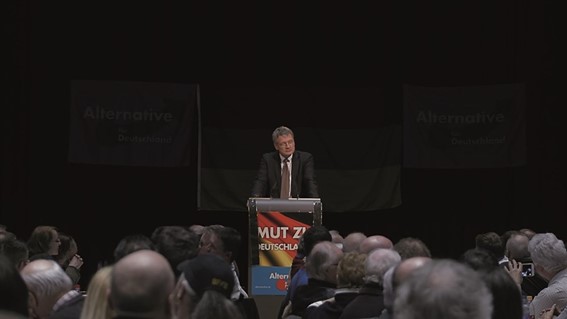
In the days of Trump this kind of film is imperative to see. Trump is an extreme ranter and joins other right wing, fascist oriented leaders in Western democracies. Meuthen’s Party reveals another sort of right wing leader more in the style of Mike Pence. Meuthen is an economics professor who enters German politics with the leading right wing party. Unlike the more extreme members he puts force a more moderate face, backing off outrageous rhetoric and working to win over more centrist oriented voters. The director gets permission to follow him during his campaign and gives us an inside look at this new kind of right wing politician. Meuthen is successful in overcoming protestors and winning over the votes with a very moderate and rational approach. What changes is when we get to follow him to the party convention where his true political views are revealed to be as odious as any of his more crazed colleagues. It is a very scary film since Meuthen wins and leads his party to a “respectable” result although not to the point of taking power at that time. Democracies must remain on the watch for similar politicians who might reach for power in these tumultuous times.

Let There be Light, Directors – Mila Aung Thwin and Van Royko

This ranked as one of my favourite films if not my favourite film of the whole week. The topic is kind of geeky – Fusion power. Fusion is the process of generation nuclear power by fusing atoms rather than blowing them apart which is called fission is what we are doing in our current nuclear reactors. The latter is also the process used in hydrogen bombs. The important difference is that fusion power is safe, creates helium rather than nuclear waste and uses water rather than uranium to generate the energy. It is the process that stars use to generate heat and light and would be a clean, virtually boundless source of energy for billions of years to come. The problem is that it is really really hard to do. The process is to drive two hydrogen atoms together to fuse them and in doing so release energy. The problem is that atoms do not want to fuse and to make it happen you need to get them moving at tremendous speed so that the forces that keep them apart are overcome. This means heating them to 150.000.000 Kelvin which is very very hot; basically, the temperature at the centre of the Sun. Currently there is project to build a fusion reactor in France with funding from several different countries. The problem is that enthusiasm for the project is not great. The cost of building the ITER or International Thermonuclear Experimental Reactor is a few billion dollars but the payoff of success is immeasurable. No more need for fossil fuels, solar energy or wind turbines. An unlimited source of energy would be at our disposal. The film visits the site of the reactor construction in France but also visits other physicists who are working on alternative approaches including a promising project in Canada. Interviews with everyone from the physicists to the construction workers on the site make the story come alive. Creative use of animation also helps us to understand the project and its promise as well as the physics behind the process. Two very depressing points are made. Funding is fragile and difficult to keep coming. Governments are not keen on an experiment that costs billions and will not be able to be conducted for 2 or 3 decades. Interest in fusion in the academic physics community is dwindling and few students are interested in taking on this area of research. The future of the projects is threatened by this kind of attitude. At the Q and A after the film we had the directors and the two leading physicists from the ITER project and our own independent Canadian initiative. They both made the point that governments are fine spending billions on things like the Olympics or the World Cup of Soccer but are not willing to invest in the future of mankind because it looks like it will take to long to realize. As we face climate disaster it is bizarre that we can’t find the money to fund a realistic and dramatic solution to our energy needs. Somehow the directors made this film and its topic entertaining and fascinating. Enjoy.

For Ahkeem, Directors – Landon Van Soest and Jeremy S. Levine


This film is in total contrast to Step. Set in St. Louis it describes the struggles of a young high school student from a poor and underprivileged neighbourhood to overcome incredible obstacles to achieve her goal. The documentary follows her over two years with incredible intimate and emotional scenes. In this case however it is the public school system that comes through. St. Louis has established a school to support kids who for a variety of reasons are not making it in the regular school system. They have been suspended or expelled for a variety of behavioural issues and are placed here for their last chance. The school is however amazingly supportive. Daje is the 17-year-old student who is sent here after being expelled. She understands this is her last chance but circumstances of poverty and racism make it very tough. She is distracted by a boy friend, a pregnancy and birth of her son, Ahkeem, during her senior year. Does she continue or does she drop out to raise her son? In the end, she survives all the ordeals and graduates. The film focusses not only on her amazing story but on the nature of a society that puts many black students in urban America on a school to prison pipeline from which escape is incredibly difficult. One of the great parts of the festival is the Q and A at the end of many films. In this case we had not only the directors but also Daje who gave us more about the story. Sadly her boyfriend and father of Ahkeem did not escape the prison ending and is currently serving 7 years for what amounts to misdemeanours like possession of marijuana, driving while black and not showing respect to the officers who stopped him, and not meeting his parole requirements. Seven years! As for Daje however she starts an ultrasound technician training program this fall. One of the more moving scenes in the film is her visit for an ultrasound and seeing her fetus on the scope and learning it would be a boy. Her career path made so much sense.

This film also raised another issue for me. The two directors are white males. Daje was asked about this in the Q and A and made light of it. She noted that when they arrived at the school to ask for volunteers to be in the film, Daje and the other students were suspicious because, as Daje remarked, most encounters with white males in her neighbourhood and experience involved cops or some other kind of racist oriented trouble. However she liked the guys and was the one to volunteer for the film. She really liked the outcome of the movie and while some of the experience was difficult for lots of reasons she trusted the directors and what they were trying to do. I went to a second film that day and sat behind some people who had also seen For Ahkeem. Their friends asked how they liked it and their only comment was: “Its problematic, a film about a black girl made by a couple of white guys.” I guess they didn’t stay to hear Daje. In these days of political correctness and cultural appropriation I suppose there is some justification for this statement. I however learned a lot and the film is a great critique of our racist society, how we can work to overcome it and how public education properly funded can be part of that solution. Look for this film for an inspiring story.

Death in the Terminal, Directors – Asaf Sudry and Tali Shemesh

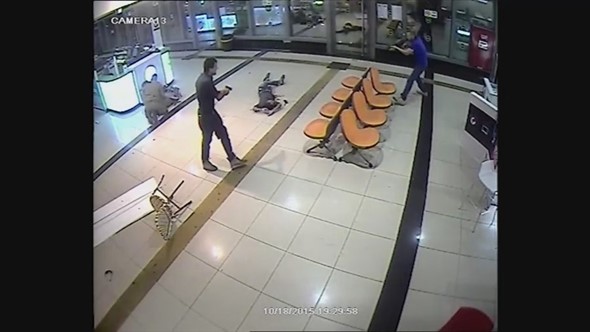
This film I saw late in the week but it is a remarkable and unusual documentary. The directors tell the story of a terrorist attack at a bus terminal in Be’er Sheva, Israel in 2015. The unique aspect of the film is the use of film from the surveillance cameras in the terminal which documented the actions of security guards, police and civilians caught up in the attack. Most the film is made from this surveillance footage although there are some short interviews with some of the participants and survivors. The incident itself resulted in several injuries and three deaths, including an Israeli soldier, the terrorist and one innocent victim. The latter is very much the focus of the film. The surveillance cameras document a single victim who is shot several times by a security officer and left bleeding to death on the floor. He is kicked and abused by several civilians who also assume he is one of the terrorists. It turns out he is an Ethiopian immigrant completely innocent of anything. The assumption of the security guard leads to his death and abuse. The film is difficult to watch and for much of it you assume the victim we see is a terrorist. It is only near the end that the truth emerges. The film illustrates what the fear of terrorism can do to otherwise civilized people. It also is an open critique of the inability of the Israeli security forces to cope or respond appropriately to terrorist attacks. The security guard who killed the innocent man was never charged although several of the citizens who assaulted him after the attack have been criminally charged.

One of the most amazing parts of the film is at the end. The tape of the main surveillance camera is rewound and the whole event unfolds in reverse. Stunning.

City of Ghosts, Director – Matthew Heineman

One of the themes of the festival this year is Syria and the Middle East with several films that address the conflicts there. City of Ghosts is about the city of Raqqa, an ancient Syrian town that has been a focus of conflict between ISIS and the Syrian government. The town has suffered under the rule of ISIS and the bombing and conflict it has endured. To highlight the situation there and in Syria generally a group of citizen journalists based in Raqqa have fought back with social media and created an organization known as RBSS or Raqqa is Being Slaughtered Silently. The group has gained international recognition and shown the power that citizens can have if they are determined and compelled to act by the horrors of the situation in which they live. Members live and report from Raqqa but many have fled to Europe to continue their work. Under constant threat, those who have left live in safe houses in Germany and Turkey. Nonetheless ISIS has managed to find some of them and assassinated them. The fear is real but so is the determination to keep up the struggle. Heineman, the director is a skilled reporter himself and is known for his earlier film, Cartel Land, about vigilante groups in Mexico that have arisen to fight the rise of Drug Cartel’s in rural Mexico. The latter is available on Netflix and I imagine this film will be also in the near future. Definitely worth your time to understand the situation in Syria today.